

Continuously serving Kosciusko County since 1854
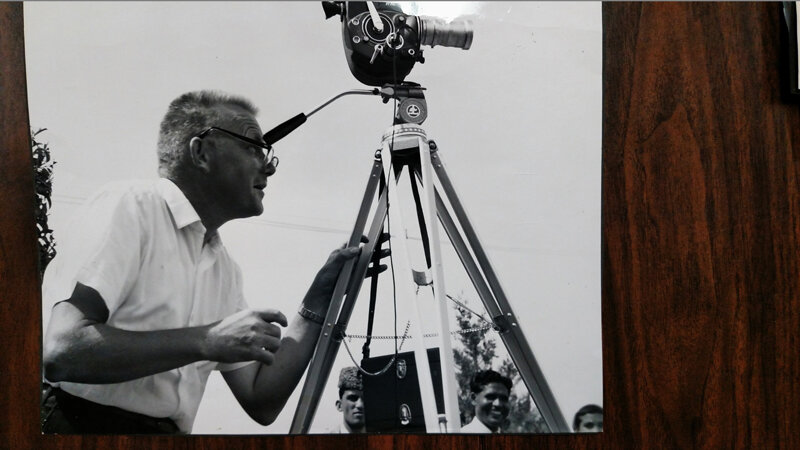
Hundreds — perhaps thousands — of evangelical churches used Ken Anderson films for ministry during the 1960s, ‘70s, and ‘80s. The films were shown in Sunday night services, at youth rallies, at New Year’s Eve watch parties, and more.
Those films — some documentary in nature but many fictional — originated from the Ken Anderson Film studios in Winona Lake. The building on Winona Avenue where most of the films were generated now houses Fellowship Missions.
Ken Anderson (1917-2006) was the creative genius behind the company, doing most of the script writing and much of the directing for the more than 200 Christian films that KAF produced.
Born in Buena Vista County, Iowa, Anderson was raised by a godly grandmother and father following the death of his mother shortly after childbirth. In 1938 he married Doris Jones, who became known worldwide as “Mrs. A.”
Anderson attended Wheaton and Trinity colleges, and was licensed to the ministry by the Evangelical Free Church. He pastored in Isle, Minn., and later in Newman Grove, Neb..
In the early 1940s he got involved in the newly-formed ministry Youth For Christ, which was founded in Winona Lake by Billy Graham and others. Anderson became the first full-time editor of the YFC magazine, known later as “Campus Life” magazine. He taught magazine writing at Grace College and he was a participant in the 1949 all-night prayer meeting in the Rainbow Room of the Westminster Hotel that launched Billy Graham’s ministry with his 1949 Los Angeles tent crusade.
Through YFC Anderson met Bob Pierce, who invited him to China in 1948, where the two preached to tens of thousands of young people in more than a dozen cities. Shortly after the trip, Pierce founded World Vision and Anderson became connected to Baptista Films where he wrote and directed his first dramatic films.
In 1949 his YFC friends encouraged him to establish his own Christian film ministry so he moved to Muskegon, Mich., and launched Gospel Films. Their first studio, in 1952, was an abandoned dance hall. Anderson wrote and produced at least one new film each year through 1960.
With a growing desire to produce films beyond North America, Anderson moved to Winona Lake in December 1960 and established Ken Anderson Films, which eventually produced more than 200 Christian films, including original dramas in many countries around the world. Anderson recruited many local residents to act in his films. He created interest and excitement by filming scenes such as a car rollover scene on Buffalo Street in Warsaw for his film “Senior Year.”
Introducing Liam Neeson
One of his best-known films is “Pilgrim’s Progress,” produced in 1977, which featured a young Northern Ireland actor named Liam Neeson (real name William John) in his first screen role. Wikipedia’s entry on Neeson says, “In 1976, he joined the Lyric Players Theatre in Belfast, where he performed for two years. He got his first film experience in 1977, playing Jesus Christ and The Evangelist in the religious film ‘Pilgrim's Progress’ (1978).” More than 1,400 copies of the film were distributed, and it was translated into many languages.
Neeson has received many accolades, including nominations for an Academy Award, a BAFTA Award, three Golden Globe Awards and two Tony Awards. In 2020, he was placed seventh on “The Irish Times'” list of Ireland's 50 Greatest Film Actors. Neeson was appointed Officer of the Order of the British Empire (OBE) in 2000.
He acted in school productions during his teens. His interest in acting and decision to become an actor were influenced by Ian Paisley, founder of the Democratic Unionist Party (DUP), into whose Free Presbyterian Church of Ulster Neeson sneaked. Neeson said, "[Paisley] had a magnificent presence and it was incredible to watch him just Bible-thumping away... it was acting, but it was also great acting and stirring too."
Ken Anderson went on to establish International Films in the mid-1960s to promote international productions, and in 1991 he founded InterComm to continue the international version of Ken Anderson Films.
Anderson traveled around the world many times, ministering and working in nearly 100 countries. In 1975 he was invited by Dr. John Haggai to teach audiovisual evangelism and journalism to national Christian leaders at training centers in Singapore, Maui, and Bogota, Colombia.
Anderson’s writing career spanned seven decades. He published 77 books, including “Where to Find It in the Bible,” published in 1996 by Thomas Nelson Publishers, which has now sold more than four million copies.
A lifelong member of the Gideon International Bible Ministry, Anderson purchased a farm near Claypool, which was featured in his film “Toby’s Treehouse,” among others. The farm later became a retreat and camping center for Grace College students and Christian groups.
The Andersons raised seven children. Anderson died March 12, 2006, at age 88. His memorial service was held at the Winona Lake Presbyterian Church (now named Church of the Good Shepherd).


