

Continuously serving Kosciusko County since 1854
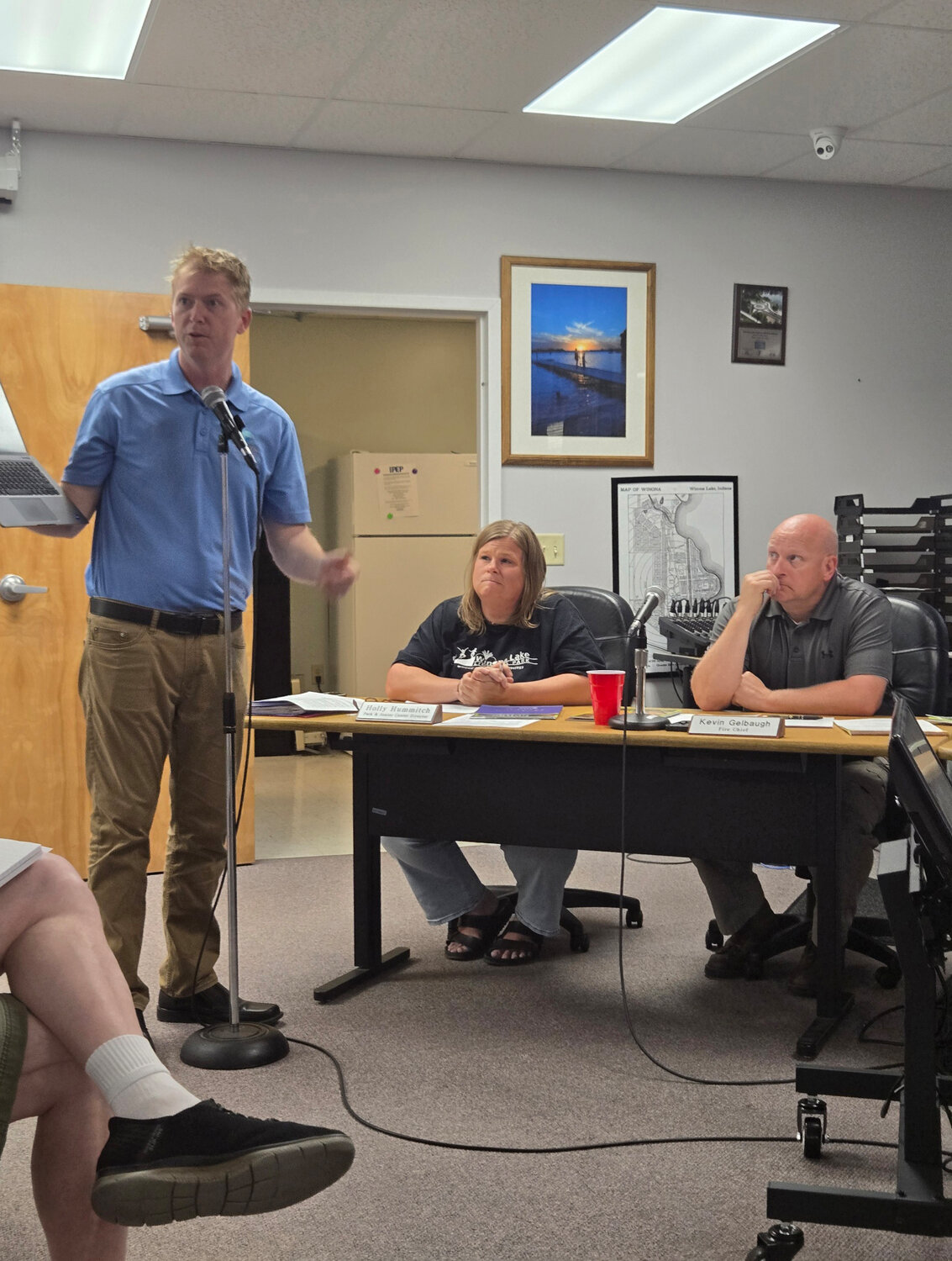
WINONA LAKE – Winona Lake Town Council received an update Tuesday from the Lilly Center for Lakes & Streams on some of the things they’ve been working on.
Dr. Nate Bosch, Lilly Center for Lakes & Streams director, said when the economic impact from Winona Lake is looked at, the lake generates about $1.3 million in annual property tax revenue. He said about 70% of the homes around the lake are secondary homes and the center is defining that based on whether the property owners are given homestead property tax credit for the property or not. The property values total over $183 million around Winona Lake. The total county lake economic impact for Kosciusko County is $422 million.
He said the lake makes up part of the identity of Winona Lake, but also helps drive a lot of the economic impact throughout the town and county.
Bosch also talked about a study that was done.
The U.S. Environmental Protection Agency approached the Lilly Center a few years to try a new tool for predicting property values based on how clean or dirty area lakes were. The center applied the tool to 14 local lakes, including Winona Lake, and over 9,000 homes.
What was predicted is if those 14 lakes were made 1 foot clearer, there would be a $122 million increase in home values along those 14 lakes. If Winona Lake was just looked at, there would be an $18.3 million increase.
Bosch showed some data going back to the early 1900s. He said Winona Lake is getting less clear over time. There is also less oxygen in the bottom of the lake than there used to be.
The Lilly Center samples 16 lakes every week from Memorial Day to Labor Day and Winona Lake is in about right in the middle as far as water clarity. The reason for that is because of the algae that grows in the lake, which is fed by nutrients that come into the lake. The center looks specifically at phosphorus and nitrogen, which causes algae, and sometimes toxic algae, to grow.
When the center looks at what’s recommended, the phosphorus and nitrogen levels in Winona Lake are higher than what’s recommended, so those levels need to come down so a better quality of lake can be seen in the future.
One of the things the Lilly Center is laser focused on is blue-green algae, because they see blue-green algae toxins as the biggest threat to the lake. There are some other lakes in the area that have much more toxins than Winona Lake. The curious thing is Winona Lake is less clear than some of those lakes, Bosch said. Winona Lake has a higher algae population, but a lower toxin production. The Lilly Center is currently researching the issue to try to figure out the issue to try to reduce the toxin level in the lake.
At the beginning of the meeting, the council held a hearing for its proposed 2026 budget.
The proposed budget totals $5,572,490. The casino/riverboat fund is $125,000. The rainy day fund is $100,000. The general fund is $1,747,960. The local road and street fund is $200,000. The motor vehicle highway fund is $787,680. The park fund is $266,080. The cumulative capital improvements fund is $50,000. The cumulative capital development fund is $198,000. The economic development income tax fund is $733,225. The home-rule opioid restricted fund is $98,980. The TIF Winona Lake fund is $141,015. The TIF residential fund is $213,700. The home-rule fund - law enforcement operations fund is $10,000. The home-rule fund - school resource officer fund is $100,850. The Community Crossing Match Grant fund is $800,000.
During the hearing, resident Jerry Nelson asked about the 35.52% levy increase from $1,084,011 to $150,046 seen in the general fund. There was also a 9.39% levy increase in the motor vehicle highway fund from $215,751 to $236,000; a 8.95% increase from $179,896 to $196,000 in the park fund; and a 9.17% levy increase from $141,567 to $154,550 in the cumulative capital development fund.
Clerk-Treasurer Heather James said the increase was due to a couple reasons. She spoke with representatives from Baker Tilly and they discovered the town “for this year only was eligible for an additional levy of over $150,000. And after discussion with them, they increased all of our levy numbers. That was done to make sure we received our maximum 4%. So when the (Indiana Department of Local Government Finance) reviews everything to approve it, if those numbers are too high, it’ll adjust them down. It’s just to make sure we get our maximum 4%.”
Nelson asked what the maximum 4% was for. James said it was for the maximum available taxes and that’s set by the state.
Nelson asked if there was a justification for why the town needs that extra money “or are we just going to take it in and spend it.” He said it’s a large increase and it’s going to reflect with the taxpayers’ levy when “you issue that that in spring and fall in taxes.”
James said there are a couple of projects she is working on with the council and Town Manager Pamela Howard, but nothing has been decided on any particular project yet.


