
Continuously serving Kosciusko County since 1854



Two letters of support for READI 2.0 grants were unanimously approved by the Warsaw Common Council Monday night.
Both letters are from Warsaw Mayor Jeff Grose, who was absent from Monday night’s meeting. One was for the READI (Regional Economic Acceleration and Development Initiative) 2.0 Arts & Culture Initiative Grant, and the other was for the READI 2.0 Blight Removal Grant.
Terry Sweeney, Main Street Warsaw director of development, said Lilly Endowment and the Indiana Economic Development Corporation partnered to create the two grants. “We’re asking for support for making an application for projects contained in the Cultural District Plan that was a seven-month-long process that was concluded in November when we released the plan,” he said.
Warsaw Community Economic and Development Director Jeremy Skinner said what Sweeney and his group, in conjunction with the city of Warsaw, was asking for, based on Grose’s request, was the city council give approval to him to submit letters of support on behalf of the projects they’re submitting for the grants. The applications are due April 15, Skinner said, and Sweeney’s group has been “diligently” working to put the grant applications together.
Council President Jack Wilhite pointed out the window for the grant opened Feb. 15, and Sweeney said they only became aware of it on Feb. 17. It then took a while for the proposal to be put together.
Skinner explained, “This money was allocated by the former governor as part of READI 2. So when the former governor did the READI 2 money, Lilly piggybacked with $250 million to go along with those funds. But their funds were restricted to arts and culture and blight. As we worked through that project with the state and the READI 2, and each district region did their submission, at one point Lilly kind of pulled back and wanted some more dedicated thought into the projects that were submitted that were associated with that $250 million blight and arts and culture.”
Each region then was given money to do a cultural district regional plan. “At the same time we were doing that, we were doing our own cultural district plan so that we could go after these funds,” Skinner said.
Projects included in the grant application include a festival street, adaptive redevelopment of the former First Christian Church into a multi-use arts venue, Buffalo Street Art Trot and Art Sculpture Play Park, and an alley activation.
If the grant is awarded, the projects still have to be made feasible, Skinner said, and they would have to go through a number of approvals. “At this point, what we’re doing is presenting a cohesive plan to them that this letter talks about in support,” he said.
In other business:
• Wilhite, on behalf of Grose, read a proclamation for Court Appointed Special Advocates (CASA) of Kosciusko County for National Child Abuse Prevention and Awareness Month.
CASA Director Erin Rowland Jones said, “April is Child Abuse Prevention Month in the United States. The goal was simple but powerful to have this month. It was to raise awareness that preventing child abuse is a shared responsibility between families, communities and systems. Over time, the movement has grown and one of its most recognizable symbols is that of the blue and silver pinwheel.”
CASA had its pinwheel-planting garden ceremony on Wednesday. Since the planting of pinwheels did not happen that day due to the weather, she said they will be planting pinwheels at some point this month and that will be announced.
“CASA often gets involved in the cases once abuse and neglect have happened, however, we have focused a lot of grant monies, as well as staff time, to providing advocacy in some other cases where the court appoints us and believes there could be a safety issue, although it may not have gotten yet to the point of abuse and neglect. And we increased our role in those cases by 64% between 2024 and 2025,” Rowland Jones said.
To date, she said CASA has served 149 children in 2026, which is 50 less than what CASA did in total in 2025. They have 41 active volunteers, and graduated eight new volunteers this year already. A new class starts April 30, so if anyone is interested they can contact the CASA office or go online at casachildren.com.
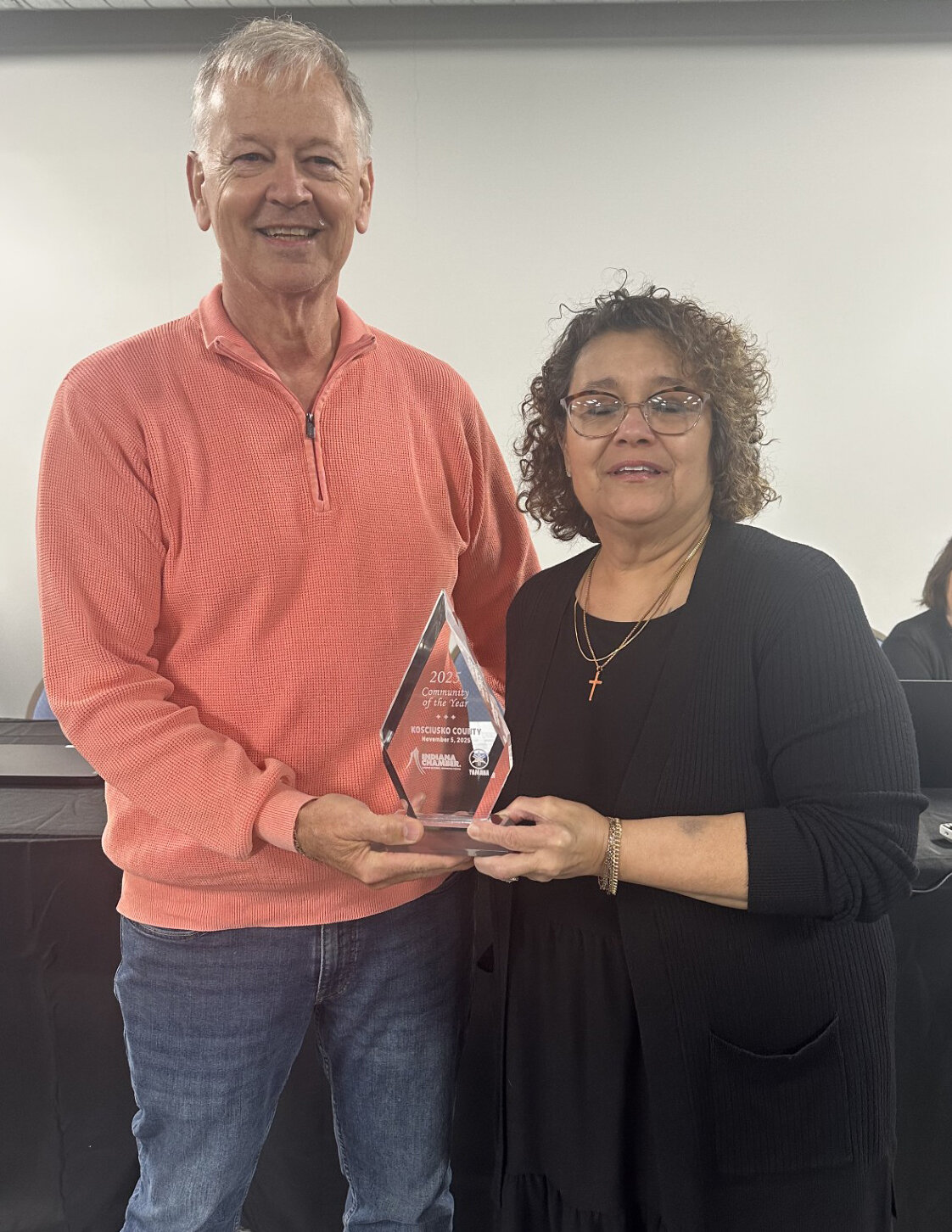
• Kosciusko Economic Development Corporation CEO Peggy Simmons presented a replica of the Indiana Chamber of Commerce Community of the Year Award Kosciusko County received in 2025 to the council.
“Tonight is a moment of pride, not for one person or organization, but for the entire community. Kosciusko County was recently named the Community of the Year by the Indiana State Chamber of Commerce. That recognition did not happen by accident,” she said. “It happens because people show up, invest, lead and believe in something bigger than themselves.”
The award belongs to everyone in the county, she stated.
“While no single person or organization can claim this honor, we do want to recognize that the All In Kosciusko served as the catalyst for this achievement, and that Jim Lancaster helped carry that vision forward through the application process. This is what collaboration looks like when it’s done right,” Simmons said.
She said the award represents momentum, belief and “what people (can achieve), when a county aligns around a shared vision for its future. And that’s why KEDCO is doing something intentional.” KEDCO has been presenting a replica of the Community of the Year Award to each of the 14 communities across the county. “Because excellence doesn’t just live in one place, it lives in every town, every neighborhood, every corner of this county.”
The replica is more than a symbol, it’s a reminder that “you are part of something exceptional. A reminder that your community helped earn this recognition, and a reminder that the work continues.”
• Fred Helfrich and James Bausch, representing the Ride+Walk Advisory Committee, updated the council on what’s been happening with the committee and its history.
“The Ride+Walk is an advisory and advocacy committee, focusing on pedestrian and cycling initiatives. We have no ultimate say in anything. We don’t have a budget, no direct funding, but we’re here to evaluate, guide and coordinate the communities’ efforts on those two topics, specifically bicycling and pedestrian initiatives,” Bausch said.
The benefits of creating a culture that is friendly toward bicyclists and pedestrians include higher property values, increased local retail spending along bicycling and pedestrian corridors, the creation of a tourism and destination economy and more, he listed.
Helfrich gave the history of the committee, starting with a series of Kosciusko Leadership Academy white paper projects in the 1990s.
Bausch then talked about those who are involved in the committee, who meets on a monthly basis. Every third month, it’s focused on the entire county. He talked about everything they’ve accomplished in the areas of enforcement, education, evaluation and planning, engineering, and encouragement and fundraising.
“Looking forward to the future, we want to continue the execution of the existing master plan. We want to see connection between the communities of Winona Lake and Pierceton, North Webster to Syracuse. We want eventually to connect here to Mentone, here to Milford as well,” Bausch said. “We want to live out the complete street light set, so that all users of the public way have safe passage. We want to work alongside government leaders as advisers and leaders in this realm.”
He said they want to see progress on projects.
• Skinner presented the council with the Warsaw Redevelopment Authority Financial Report for 2026 for their review. He did not go into detail about it but said the report presentation will be given to the Warsaw Redevelopment Commission at their 4 p.m. April 14 meeting.


