

Continuously serving Kosciusko County since 1854
Most hymns and gospel songs have a “back story” that provides material to help understand the context, the origin and the meaning of the song.
“Beyond the Sunset” is the quintessential gospel song that reflects the 20th century songwriting style that made Winona Lake and Rodeheaver Hall-Mack Publishing Company the world’s leader in the genre.
According to Hymnary.org, the composer, Virgil Prentiss Brock (1887-1978), was born in Celina, Ohio. In his early years he was a member of the Quaker (Friends) Fellowship, and he graduated from Earlham College with a B.A. degree, followed by further study at Cleveland Bible Institute and Training School and Trinity College.
He lived in Winona Lake for many years and was a close associate of Homer Rodeheaver, who owned Rodeheaver Hall-Mack Publishing Company, a leading publisher of hymnals and gospel music.
In 1914 Brock married a co-worker named Blanche Kerr, and they collaborated as hymnwriters for 43 years. Brock described her as “the belle of the community and a good singer and pianist.” Their only child, a son, became a professor of theatre at California State University Northridge.
Having felt a call to preach, Brock gave most of his life to evangelistic endeavor. As an adult, he was a member of the First Christian Church of Warsaw. Brock authored more than 500 hymns and gospel songs in his lifetime.
Brock greatly admired Homer Rodeheaver and his publishing company and so he “contributed a few scholarships” to help launch what soon came to be known as The Rodeheaver School of Sacred Music. He served on the school’s faculty and his compositions were often featured in the Festival of Sacred Music programs at the close of the music school each year.
Rodeheaver owned “The Hillside,” a large, three-floor rooming house which had been his first home in Winona Lake. It was located at the end of Swiss Terrace, just behind the Billy Sunday Tabernacle, and Rodeheaver offered to sell it to Brock at a bargain price. Brock bought it and became the proprietor of a restaurant/tea room which operated under the first-floor veranda of the Hillside.
Later the Brocks moved to Indianapolis where he founded a group of business and professional men known as the Christian Laymen’s League. Its purpose was to evangelize the neglected areas of the city. He secured a generous gift and pledge of support from J. I. Lilly, president of the Eli Lilly Pharmaceutical Company.
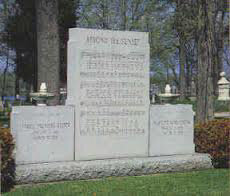
When Brock’s wife Blanche died, an unusual and noteworthy stone monument was erected over their grave in Oakwood Cemetery in nearby Warsaw. Made of granite, the memorial featured engraving of both the music and the words to the Brocks’ best-known composition, “Beyond the Sunset.” The memorial was dedicated on Memorial Day, May 30, 1958. The Rodeheaver Hall-Mack company bore a significant portion of the cost of the memorial.
In his autobiography, titled “You Asked For It,” Brock detailed the background story of a number of his compositions. One of his best-known, “Beyond the Sunset,” was born at a dinner party in 1936 at Rainbow Point, the lakeside home of his publisher, Homer Rodeheaver. Here, in Brock’s own words, is the story:
“Noticing that a brilliant sunset was forming, we hurriedly drove with a blind cousin and his wife to Rainbow Point, home of the Rodeheavers on the east lake shore, and joined a group who had preceded us. The unusually glorious scene on a wide area of the water contrasted impressively with dark storm clouds.
“After our prayer at the dinner table, our blind cousin excitedly remarked, ‘I never saw a more beautiful sunset!’ Knowing he had gotten his vivid impression from the comments of others at the lakeside, I told him we understood his remark, but that others were amazed when he talked about seeing.
“‘I do see,’ he quickly replied. ’I see through other peoples’ eyes, and I think I often see more, I see beyond the sunset!’ The phrase ‘beyond the sunset,’ and the striking inflection of his voice, struck me so forcibly I began singing the first few measures. ‘That’s beautiful!’ his wife interrupted. ‘Please go to the piano and sing it!’
“The entire verse was quickly finished at the piano and we returned to the table. ‘Virgil, you ought to add a verse about the storm clouds,’ our blind guest suggested, and it was immediately jotted down with the first verse. Recalling how closely our guests had walked hand in hand together because of the blindness, I added the third verse, and before the evening meal was finished the fourth, too, was added.”
Beyond the sunset, O blissful morning, when with our Saviour heav’n is begun. Earth’s toiling ended, O glorious dawning; beyond the sunset when day is done.
Beyond the sunset, no clouds will gather; no storms will threaten, no fears annoy; O day of gladness, O day unending, beyond the sunset, eternal joy!
Beyond the sunset, a hand will guide me to God the Father, whom I adore; His glorious presence, His words of welcome, will be my portion on that fair shore.
Beyond the sunset, O glad reunion with our dear loved ones who’ve gone before. In that fair homeland we’ll know no parting-beyond the sunset for evermore!
After the death of Blanche, Virgil eventually remarried. When his second wife died, Brock felt he should gift the home they were living in to Child Evangelism ministries. The house was sold and the funds, along with other contributions, funded a new facility on a two-acre wooded tract on U.S. 30 to serve as the ministry’s headquarters. The grounds of the Martha Brock Memorial Center were dedicated in March 1972.
During the last six years of his life, Virgil Brock lived at Youth Haven Ranch, Rives Junction, Michigan. At the time of his death at age 91, he was still being called upon to present programs.


