

Continuously serving Kosciusko County since 1854

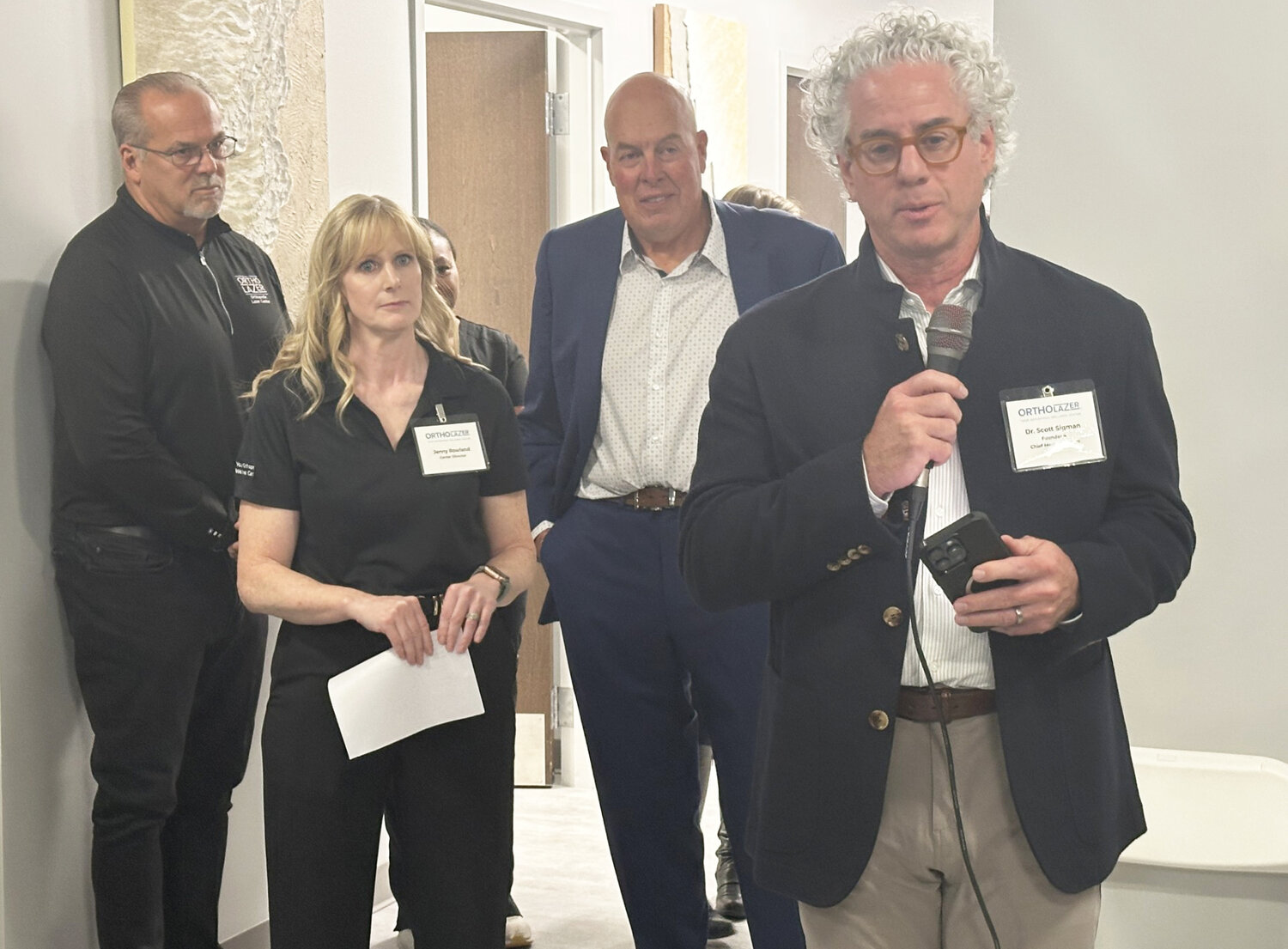


OrthoLazer was born out of the idea of trying to develop a solution to the opioid crisis, according to Dr. Scott Sigman, OrthoLazer founder and chief medical officer.
“And I would venture a guess that just about every single person in this room knows someone that was affected by the opioid crisis,” he said Wednesday at the ribbon-cutting and grand opening for OrthoLazer’s new corporate headquarters and flagship Orthopedic Wellness Center at 902 Provident Drive, Suite C, Warsaw.
The idea of OrthoLazer started about 2018, and the Warsaw Orthopedic Wellness Center is OrthoLazer’s 18th center, having just opened up one in Sarasota, Fla., two weeks ago.
Sigman, who has been in practice as an orthopedic surgeon for 30 years, said, “I was told that what I do is going to hurt people, it’s true - we use saws, we use drills and all those things to fix and heal our patients. Yes, it causes pain. And I was told, ‘You’re going to use opioids because opioids are not very addictive and they’re really indispensable.’ And how far from the truth was that?”
Health care providers found themselves contributing to the opioid epidemic and didn’t really understand that at the time.
“Once I realized that, it really became my mission in my clinical practice to develop a strategy to help break us away from opioids and be able to come up with this idea,” Sigman said.
He talked about photosynthesis and how human cells have evolved over time underneath the sun.
“And so, light is actually our super power. If you can shine the right wavelength of light into our cells, we can create a cellular mediated response that eliminates pain, helps to reduce inflammation and it actually is a healing process that can occur. No medications. No injections. No side effects. Shining light into our joints, into our tendons, creates a healing response. It really is quite remarkable, and that is the foundation of OrthoLazer,” Sigman stated.
OrthoLazer’s mission at this time, he said, is to “democratize laser as a treatment option to heal patients for their pain, for their inflammation, avoiding opioids and really allowing the healing with light around the world.”
OrthoLazer CEO Rod Mayer said this is his 48th year in orthopedics and he’s seen a lot of unique medical devices birthed.
“And many times there were a pioneer behind those medical devices, and those pioneers were often ridiculed because they were so far ahead of the curve in their thought process. That’s Dr. Scott Sigman,” Mayer stated. “Because he had a vision and a passion to address an epidemic here in the United States, and he did so because of the passion he has for the patients that he serves.”
He said they’ve coined a simple phrase they’re going to be “surgeon-driven, patient-focused and community-centered.”
Continuing, Mayer said Warsaw/Winona Lake might be a small community, but they have huge hearts.
“And I’m incredibly passionate about what we’re going to build across the United States. Our mission is to keep every body moving, pain free, while championing their personal success. We’ve already seen phenomenal results right here in this center with our science, with our Class 4 laser device. Proprietary technology only available to OrthoLazer,” he stated.
OrthoLazer is going to continue to educate the community on the benefits of the therapy, and he said they’re confident that they’re going to see high school and collegiate athletes receive benefits from it.
“We’re going to see this spread throughout our community. We believe whole-heartedly that our primary care physicians in this marketplace will begin to embrace this. Scott was the one who pioneered the history, we’re going to keep this history evolving and growing, expanding across the United States,” Mayer stated.
He thanked the Cedars Holding Group for their investment and their belief in OrthoLazer, as well as the K21 Health Foundation.
“We’ve seen the transformation of this facility into what you see today,” Mayer said. “So to all of our investor partners, that are here today, we thank you. We’re looking forward to continuing to build this business together, one relationship at a time.”
Dr. Mark Klaassen, OrthoLazer surgical advisory board member and strategic advisor, said he’s been an orthopedic surgeon for 39 years.
“As an orthopedic surgeon, in this career, we see people with injuries - sports injuries, work injuries, everyday life injuries. And then, as surgeons, we’re also fixing people. We operate on them, and recovering from those surgeries is always difficult. And this whole thing of getting rid of opioids has been a passion of mine as well,” he said.
Klaassen used to think laser was “voodoo, snake oil,” but now he says he’s a true believer and Sigman has convinced him of it.
“But what really has convinced me are the results we see. It’s been the patients and the people that we have treated that have then come back and said, ‘Wow! This is amazing!’ And it’s not magic. We’re using this most powerful medical laser available, this M8 laser, and it’s a spectrum of light that you can’t see, and it penetrates your skin and penetrates your tissues to bone. It doesn’t go through bone. It’s kind of like an x-ray, only there’s no radiation,” Klaassen explained.
The laser energizes cells.
“By energizing those cells, it creates an action and that action is that it decreases inflammation, increases blood flow, makes your swelling go down, and therefore it helps pain. It’s been approved by the American Academy of Orthopaedic Surgeons for the treatment of arthritis of the knee and by the FDA, it’s been cleared. And so, it’s going to become mainstream, but it’s not yet. We’re going to drive that, and the patients are actually the ones that are going to drive that. The people treated are the ones that are going to drive that,” Klaassen said.
In an interview before the ceremony, Klaassen said, “The coolest thing is that we’re in the orthopedic center of the world, Warsaw, Indiana, and this is the first center in Indiana. There’s nothing else like it in Indiana. This is the first center, we hope to have many more, but this is the first center in Indiana.”
He said they would like patients to be referred to OrthoLazer from their healthcare provider, but they will take walk-ins. OrthoLazer staff will evaluate a walk-in’s injuries and history to determine whether they should go see their regular healthcare provider first.
“This acts on a cellular level. So it energizes your cells, so, literally, any musculoskeletal pain, or any musculoskeletal injury, you could treat with a laser, but it doesn’t go through bone,” Klaassen said.
The whole goal is to get rid of opioids.
“If I do a total knee, I would rather never give the patient an opioid. I’m going to have them do OrthoLazer therapy, ice compression, all my multi-modal pain pathways to stay away from opioids. And then to get them to heal faster. They’re going to get a better result if I can decrease the swelling, and the key is to decrease the swelling. If you decrease the swelling, they don’t have the pain, they don’t the inflammation and they’ll end up doing much better,” he said.
A person with an acute injury may require six visits to OrthoLazer. A chronic injury may require 12.
“It’s not magic. We’re basically empowering, energizing your own cells. So if you energize your own cells to heal and to react, on a chronic situation you have to wake them up first because they’ve kind of given up. So you have to wake them up, get some laser treatments to wake them up and get them going, and then you can start seeing some results. And then you might need maintenance, it just depends,” Klaassen explained.
He said they’ve been seeing patients for about the last month and the results are really enlightening and “pretty cool.”
As the procedure is relatively new, it’s not covered by insurance. However, Klaassen said normal treatment is about $80 per session. A session is approximately 15-20 minutes.
“So if you look at that, you’ll realize that’s very doable and it makes it so that, hopefully, we can get people to experience it and realize what a benefit it is to our community,” he said.
Find out more at ortholazer.com


