

Continuously serving Kosciusko County since 1854


As the issues with the intersection of Pope and Detroit streets have been “kicked down the road” long enough, Warsaw Public Director Dustin Dillon had VS Engineering provide some options.
Six were presented to the Warsaw Traffic Safety Commission on Wednesday, with the best short-term and long-term options identified, but no decision was made and no action was taken so the board members can receive public feedback until their Aug. 5 meeting.
Background
Providing some history of Pope and Detroit, Dillon said, “This is an intersection that’s kind of haunted us with issues and safety concerns for decades.”
There’s been reports of high speed use of Prairie Street to Detroit to avoid the traffic signals on Ind. 15. Reports of cars cutting the corner short, encroaching into the southbound lane of Detroit, forcing some near-miss accidents. Reports of sight issues as drivers try to turn left off Pope Street onto South Detroit with a large utility pole in the way and sometimes larger vehicles parked at Warsaw Cut Glass. Reports of cars attempting to turn left off Pope south onto Detroit not knowing whether cars heading north are turning right onto Pope or continuing straight to Winona Avenue, causing confusion there. Other reports have been about local truck traffic using Prairie and Detroit to get on Winona Avenue instead of Ind. 15, very high traffic volumes early morning and mid-afternoon and many near-miss accidents.
“So last fall, after analyzing internally that concern that has existed for decades and continues to increase, we did reach out to VS Engineering and asked them to perform a traffic study to identify the functionality grade of the intersection, traffic patterns and flows, where was traffic heading and also what are some options we could consider,” Dillon told the commission.
After VS Engineering provided that information, Dillon said they looked through that data and then further asked VS Engineering to come up with a short-term option that would address the majority of the safety concerns and functionality improvements, knowing that it may not solve everything. VS Engineering also was asked to look at some long-term options to be considered.
Options
Josh Corwin, VS Engineering project manager, said they looked at the existing conditions and identified what the concerns were. They then looked at those concerns and then six different alternatives to try to address those concerns. They then identified the best short-term and the best long-term options, and discussed the estimated cost.
Option 1 is a right-turn only island, or raised median in the middle of the road. It would prevent traffic from going north through the intersection and forces vehicles to turn right onto Pope. Westbound traffic from Pope would have to turn north onto Detroit. Southbound traffic on Detroit would have to continue south to Prairie. Corwin said this option eliminates the sight-distance issue that westbound Pope traffic has with northbound Detroit traffic.
Option 2 is similar to option 1, Corwin said, but allows left-turn movement for southbound traffic. It provides more connectivity to the southeast neighborhood.
Option 3 involves putting a roundabout at the intersection. A roundabout would slow down traffic and the sight distance required is much lower. However, to put in a roundabout, additional right-of-way would be required, he said. The first three options only address the traffic capacity at the Pope and Detroit intersections and not the Pope and McClellan intersection.
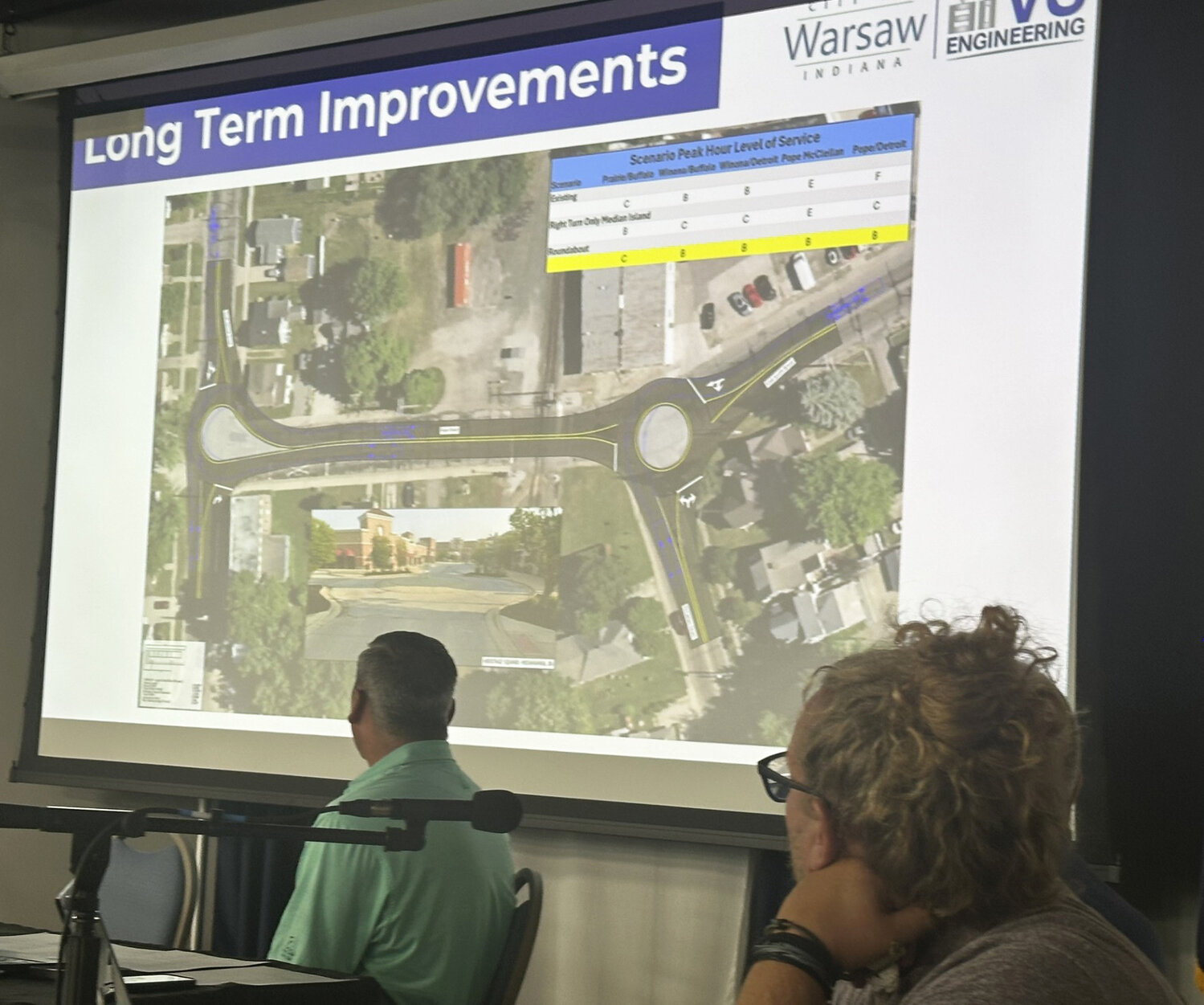
Option 4 involves what’s called a “peanut roundabout.” It addresses the capacity at both the Pope and Detroit and Pope and McClellan intersections.
“It also prevents the northbound cut-through traffic because now, if you notice, the west one is a peanut roundabout and the east one is a standard roundabout. So, with the peanut roundabout, it’s forcing northbound traffic to turn right. They can still continue around to the east roundabout, come back, go clear round through, come back to the west and then continue north, but that increases their travel time so doesn’t stop somebody from using that corridor, but it makes the travel time longer, so it deters them from doing that,” Corwin explained.
He said the cost for option 4 would be more significant and additional right-of-way would be required.
Option 5 is what Corwin called a “low-impact” option where they looked at “pretty much maintaining things, just in traffic patterns.” It would involve adding a stop sign at the corner, adding a pedestrian crossing and removing parking along the west side of Warsaw Cut Glass and adding parking to the south of the building. A delineated curve would be put in at Prairie and Detroit.
While that option does help with some of the sight distance at Prairie and Detroit, it wouldn’t help much with Pope and Detroit or with the cut-through traffic.
Option 6 would be adding stop signs to make the intersection an all-way stop.
“This does help to address the sight distance issue as all vehicles are supposed to be stopping,” Corwin said, but as everyone knows when you pull up to a stop sign, you want to make sure the other vehicles are stopping.
An all-way stop would be safer for pedestrians, but Corwin said it doesn’t do anything to prevent or address the congestion at the intersection or the cut-through traffic, but makes the congestion worse.
“So with this, it actually lowers level service to an ‘F’ intersection,” he said.
The way a level service works is similar to grades in school. It’s graded on “A” through “F” and is based on the delay and driver experience as the driver approaches an intersection. “So it’s an average delay for a driver,” Corwin explained. An “A” is the best but sometimes that’s “beyond what is necessary” and most drivers are comfortable with a “B” or “C.”
Best Alternatives
Using the criteria they looked at, the safety of the intersection, cost, improvement, cut-through traffic and sight distance issues, Corwin said they identified the best alternative for short-term implementation and ones for long-term.
For short term, he said they identified the right-turn median island that allows left-turn traffic. That would raise the level of service of the Pope and Detroit intersection from an “F” to a “C.”
“With this option, we wanted to just highlight that there is an opportunity for tactical urbanism. So this refers to a low-cost, temporary change to the build environment that is intended to improve the safety for the environment of the neighborhood,” Corwin said.
It would entail things like highly visible graphics or hay bales to tighten up intersections and simple things like that. He said it was just an option that could be looked at.
On the best long-term improvement, Corwin said it would be a roundabout. It would provide a level service of “B” and addresses all the safety issues.
Costs
Corwin then provided estimated costs.
According to the graphic displayed, a single-lane peanut roundabout would have an estimated construction cost of $1.7 million and right-of-way acquisition cost of $1.3 million for a total estimated cost of $3 million.
The mini peanut roundabout would have a total cost of $1.15 million, with the right-turn only median costing $160,000 and the right-turn-only median with pavement maintenance at $300,000.
Discussion
Discussion on the options by the commission went on for about a half hour.
The Winona Avenue and Detroit Street intersection was brought up, and Dillon mentioned it was an Indiana Department of Transportation-controlled traffic signal. However, he said if they needed to they could work with INDOT because of stacked traffic, they could get a yellow left turn arrow.
Matt Light and Linda Kirkendall, from Warsaw Cut Glass, attended the meeting.
Light said they’ve seen the Pope and Detroit intersection become more of a problem.
“We wouldn’t want to see something impact our business,” he said. “And traffic has already impacted our business. The traffic has increased there, so our customers pulling in and out of our parking lot have found it difficult with the influx of traffic.”
He said they see a lot of the problem coming from Prairie Street “with that roll of traffic instead of having a stop there.” He said a stop sign would slow that traffic down and vehicles would go around that curve at a lower rate of speed, lowering the possibility of a collision with a vehicle pulling out of the Warsaw Cut Glass parking lot.
“At Warsaw Cut Glass, we’d love to see a stop sign on Prairie,” Light said.
Kirkendall said, “Or a way to get the traffic local because over half the traffic that is coming from Prairie Street going north, and coming south going around to Prairie is all (Ind.) 15 traffic, and there are semis.”
Dillon said the right-turn-only would eliminate the cut-through traffic because there is no reason to cut through on Prairie Street because they would have to go further east to go north.
Kirkendall said she was worried about their parking lot. If anyone wanted to take the pole down there at the intersection, she said, “go for it” because the lines are dragging and it’s kind of dangerous anyway.
Light reiterated the best option for them would be a stop sign on Prairie to help slow traffic.
Corwin said there are nationwide standards that have to be followed to put a stop sign in. It was pointed out by Common Council President Jack Wilhite that any stop sign would have to have an ordinance to go with it, approved by the Warsaw Common Council.
City Councilman Mike Klondaris told the commission the conclusion he was coming to was that the best long-term alternative at the intersection would be a mini roundabout “that would allow people to go the directions they want to go.” He said until the city can afford the roundabout, he urged them to either do nothing or the least expensive thing for now.
Dillon said, “As far as the not do anything, that’s why it kept coming up and that’s why we got this. It’s a hard pill to swallow, we just keep kicking that can down the road.”
The intersection will be on the commission’s agenda again at 1 p.m. Aug. 5 at the Warsaw Police Department Training Center.
To reach out for comments, concerns or questions, email publicworks@warsaw.in.gov


