

Continuously serving Kosciusko County since 1854
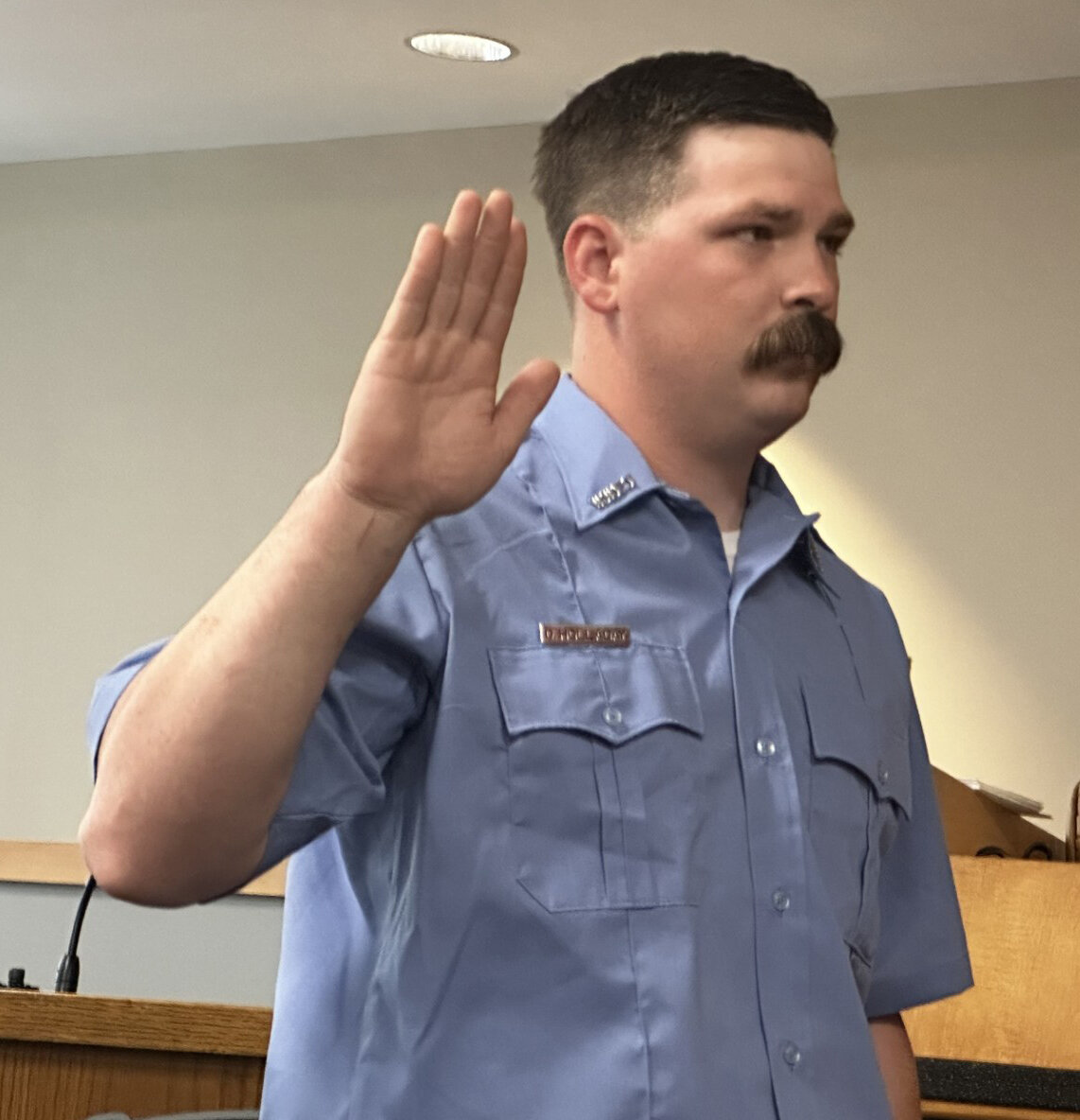


Four Warsaw-Wayne Fire Territory firefighters took their oaths of office Friday at the Board of Public Works and Safety after completing their one-year probationary period.
David Holladay, Kegan O’Brien, Myles Scott and Jacob Johnson were given their oaths by Warsaw Mayor Jeff Grose in front of their family, friends and their brothers in the WWFT.
Before that, Grose had everyone involved in emergency services stand.
“(I have) a great appreciation for what you have done and what you continue to do. My dad, I said last year when I started (as mayor), my dad, a former police officer for the city of Warsaw, (said), ‘Jeff, what you’re doing as mayor is very important, especially swearing in people.’ He says, ‘Don’t you ever forget,’” Grose recalled.
A few years ago, Grose had a small house family.
“Again, my dad saying, ‘Jeff, these people are telling everybody I’m going to run to trouble while everybody else is running away from it.’ Very serious, and I think a lot of times we forget that, starting with me. So a big thank-you to everybody that is standing. Also, a big thank-you to family that is here today for the four individuals that are going to commit to their comrades, to this community, that they’re going to run to trouble for the good of this community. Neighbors serving neighbors, so thank you very much,” Grose concluded.
Later in the Board of Works meeting, Warsaw Human Resource Director presented the new hire/change in payroll report which included updates for the four firefighters that were sworn in and their probationary period ended. The board approved the report. The biweekly full-time pay for Holladay, O’Brien and Scott is $2,363.71, with Johnson’s at $2,480.71.
The report also included an hourly pay of $14.68 for part-time firefighters Cohen Heady and Reed Nelson. Harlan explained that Heady and Nelson were part of the fire courses this past year at Warsaw Area Career Center and worked with the fire department throughout the school year. Now that they’ve graduated, Heady and Nelson are going to be brought on as part-time firefighters while they get ready to go to college. Their estimated start date is June 22.
“They have done a great job for us and we want to keep them around for as long as we can,” Harlan stated.
After the Board of Works meeting, Fire Chief Joel Shilling said he was happy to have all four guys who were sworn in Friday, and Delton Moore is coming back as well.
“All those guys are great additions to the fire department,” Shilling said. “A lot of people think that I’m just adding staffing and these are just new firefighters to us. We did add two - Jacob Johnson was one of those two with the levy appeal that we got to add to our manpower, and then that brought all of our shifts to 13. But most of those are replacements of people that have retired and/or left the department, moved on to other departments. But happy to have every single one of them.”
As far as the number of firefighters for the whole fire territory, “We have 13 per shift, with a minimum of 10, is what our minimum staffing is for all three stations. So that includes a minimum of three firefighters on each apparatus, and then a battalion chief to help manage and run the incident. As far as that, we allow two people off on vacation or personal time, or benefit time, that they’re able to use per shift. And then that leaves one person open if somebody calls in sick or goes to training.”
He said when they don’t have the manpower to staff the trucks, that’s where it becomes difficult to tell someone they can’t go to training or such.
“Unfortunately, it does happen, but we are fully staffed to what I’m capable of staffing through our salary ordinance now. We have one more that comes up at the next Board of Works meeting, which will basically bring us up to where we need to be,” Shilling said.
There’s national standards to how the fire department manages a scene that it responds to.
“Whether it’s NFPA or ISO, we have certain requirements that we have to have a certain amount of manpower on the scene within a certain amount of time of a fire. So that’s what drives those,” he said.
Fort Wayne’s fire department has been in the news lately regarding its fire chief shutting down some rigs that don’t have four people on them, Shilling pointed out.
“So that’s just something that always plays in every fire chief’s mind. You drop below three and it’s just unsafe for the guys and they can’t go. It’s unsafe for the community, so three is really that number. Ideally, it’s four though. So with the 13, when everybody’s here, each engine has four people on it,” he said.
The “manpower” at station 13 on East Center Street “jump” trucks.
“So, depending on what call it is, they go over to the rescue (truck) if there’s a call that needs a rescue. If they need the ladder truck, they take that. If the engine is sitting there as well, they can take (that). So sometimes you will see a fire apparatus driving lights and sire to the station to the pick it up because they were either at training, training on vehicle extrication and now it’s a fire call that came in, so they’ve got to race back in and get the ladder truck. It just comes back to those standards of what apparatuses are required to be on the scene,” Shilling explained.
WWFT does not have volunteer firefighters anymore. Former Chief Mike Wilson did away with them and switched to part-time firefighters.
“Now we pay them a part-time wage. They’re required to do 24 hours a month, and some do more than 24 hours a month, but the minimum to stay on the part-time roster is (24 hours). And that’s just additional staffing. That’s just a way for us, as the fire department, to boost our staffing numbers because we do not meet the minimum standard that is nationally there. But, that’s where, again, with budgets and stuff like that, and trying to be fiscally responsible, the part-time program is a way to kind of oversee that,” he said.
He said the two-year fire program with the Warsaw Area Career Center that Heady and Nelson went through is a great opportunity and relationship for the WWFT.
“They just wanted to stay on as part-timers and continue now that the school year is over and we’re just glad to have them,” Shilling stated.
As the city continues to grow with more housing, businesses and population, the point at which the fire department will need to add more firefighters in the future is complicated.
Shilling said, “There’s a lot of different national standards, again, that you kind of shoot for, and it’s all in where we want to be as a community and what we want to do. There’s a lot that goes into it, whether it’s national standards of the amount of manpower we have to have on a fire, whether it’s how many resources the fire territory board (wants to approve).”
At the last fire territory board meeting, he spoke about having six calls at one time within a couple-hours window. All the engines were tied up, as were all the apparatuses and manpower.
“So how many times does that happen? And we depleted our resources. And those are things that it’s my job as the fire chief to kind of look through and then help inform the mayor and help inform the council and those decisionmakers to influence them, I guess, to help us,” Shilling said.


